

1. What you can ask
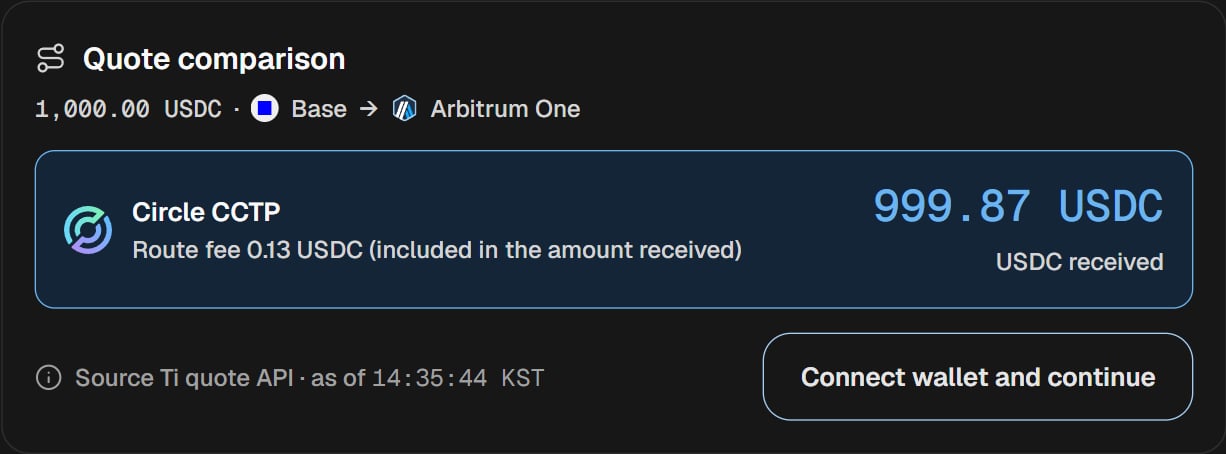
Ti AI answers what users want to know before they swap or move stablecoins. Questions can be asked in everyday language, and answers come back in the language of the question. Ti AI currently handles six types of question.“How much will I get if I move 1,000 USDC from Base to Arbitrum One?”
Route, route fee, amount received, source and timestamp
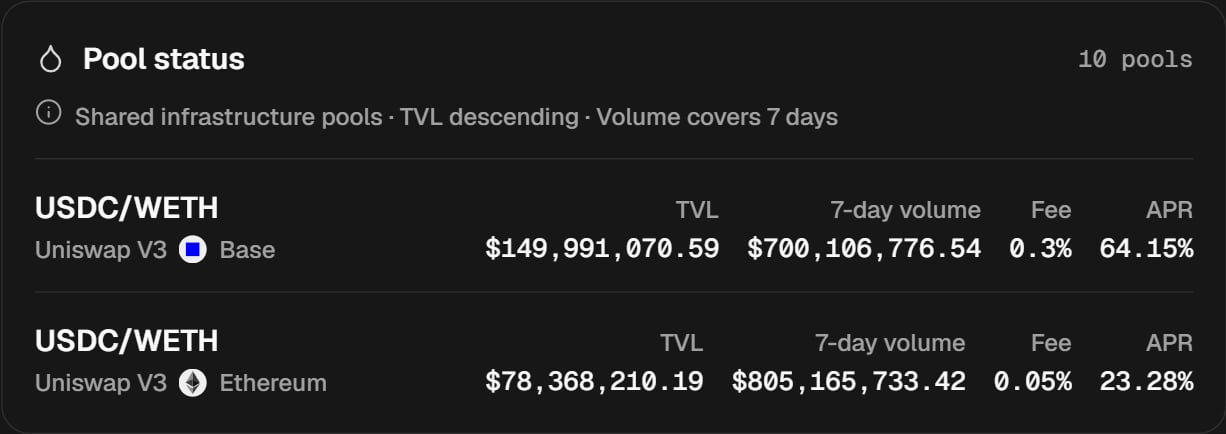
“Which USDC pool is the largest?”
Pools by TVL with 7-day volume, fee and APR
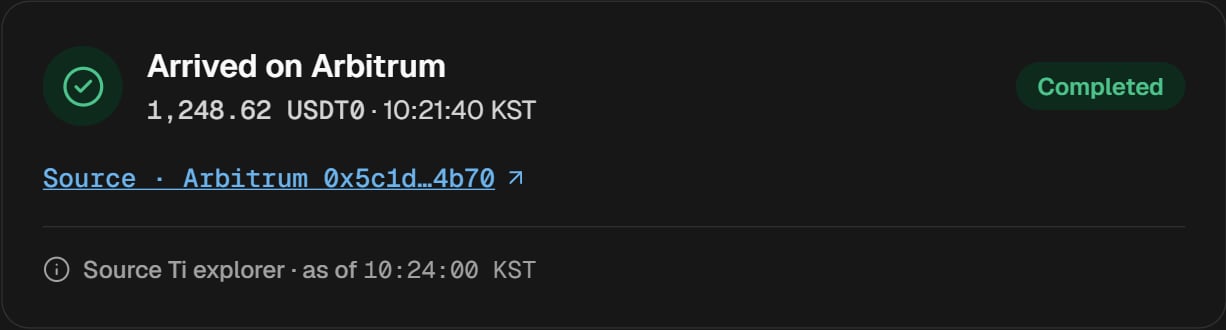
“How far along is this transaction? 0x5c1d…4b70”
Destination chain, amount, status, source and timestamp
Answer examples on the Ti app’s AI home · captured 2026-11-02
Figure 11. Ti AI calls the tool each question needs and puts what the tool returns, whether a quote, a pool ranking or a transaction’s progress, on a card exactly as returned.
Take the first question. Ti AI calls the quote lookup tool once and, in about two seconds, answers: “Moving 1,000 USDC from Base to Arbitrum One gets you about 999.87 USDC. CCTP is the only route, and its bridge fee is 0.13 USDC.” The card under the answer shows the Circle CCTP route taking 1,000.00 USDC from Base to Arbitrum One, a route fee of 0.13 USDC reflected in the amount received, and an amount received of 999.87 USDC, followed by the line “Source Ti quote API · as of 14:35:44 KST”. The 0.13 USDC is the 1.3 bps fee that Circle charges for Fast Transfer from Base, applied to 1,000 USDC.22 Pressing “Connect wallet and continue” on the card opens the swap screen with the same conditions already filled in. For a pool data question, Ti AI shows pool data aggregated by shared infrastructure, sorted by TVL. For a transaction lookup, it reads the Ti explorer’s records and shows in a card which route the transaction took, whether it used a bridge, and how long it took from creation to completion.2. How an answer is built
- Question
- Intent
- Tool choice
- Tool callpublic data · quote API
- Cardvalue · source · time
- Short answer
- builds a transaction
- signs
- executes
- asks for secrets
A real trade happens only on the swap screen, when the user approves it in their wallet.
Figure 12. Ti AI reads public data and the quote API, answers with a card, and stops before building or signing anything.
Ti AI builds an answer in six steps. First, it reads from the question what the user wants to know and the conditions it needs (chain, token, amount, transaction hash and so on). Next, it picks the tool that fits the question: the quote lookup when it needs a quote, the transaction lookup when it needs a transaction’s status, and so on. The tool sends a request to a system that holds the actual data, such as the Ti quote API, the Ti explorer or the pool and price data services, and brings back the result. The result is turned into a card in a fixed format, and finally a language model summarizes the card’s content in a short sentence. This process is visible on screen. Progress indicators such as “1 tool used · 2 sec”, “Looking up quote” and “Writing the answer” let the user see what Ti AI is doing at any moment. The language model that writes the answers is Anthropic’s Claude, called through its API.233. The card speaks for the numbers
In a Ti AI answer, the card, not the text, is the reference for numbers. Language models are good at producing natural sentences, but they can make mistakes when copying or rounding numbers. So Ti puts the values a tool returns on the card exactly as returned, without passing them through the language model. If the numbers in the text and on the card look different, the card is right. 12345
- 1RouteCircle CCTP, from Base to Arbitrum One
- 2Route fee0.13 USDC, already in the amount received
- 3Amount received999.87 USDC
- 4SourceTi quote API
- 5Timestamp14:35:44 KST. Quotes change constantly
If the numbers in the text and on the card look different, the card is right.
Figure 13. In a Ti AI answer the card is the reference for numbers: it shows the route, the fee and the amount received with a source and a timestamp.
Cards state the source and timestamp wherever possible. The single line “Source Ti quote API · as of 14:35:44 KST” tells you where and when the number was taken. Quotes and prices change constantly, so a number with an old timestamp is only a record of that moment. Ti tells users not to treat values whose source or timestamp cannot be confirmed as current. When the user actually goes ahead, the swap screen fetches a fresh quote and shows it again, and just before signing, the wallet shows the execution details one last time.4. Why Ti AI does not execute
Ti AI does not create, sign or execute transactions. It does not generate the transaction data used for signing either. Quotes are shown for reference only, and a real transaction goes ahead only when the user approves it with their wallet on the swap screen. For now, Ti AI also does not look up the user’s asset balances, missions, transfers or deposit history. There are three reasons for this design. First, a language model’s output can vary slightly from one run to the next, even for the same question. There is no reason to hand a probabilistic model an output such as transaction data, where a single wrong character changes the result. Second, the AI reads external data. Instructions hidden in a token name or a transaction memo may try to deceive the model (prompt injection). Ti AI has no authority to create transactions in the first place, so even if such an attempt succeeds, no funds move. Third, the line of responsibility becomes clear. The user makes the decision to move money after seeing the details in their wallet, and the blockchain enforces the conditions of that decision.5. Safeguards
- It never asks for secrets Ti does not ask for seed phrases, private keys or passwords. If the AI ever appears to ask for such information, Ti tells users not to enter it, and Ti never contacts users first by messenger or DM to ask for wallet information. Ti also tells users not to enter sensitive personal data such as national ID numbers.
- It labels AI answers Every AI answer carries the label “AI-generated answer · Not investment advice”. AI answers do not guarantee returns, and the final decision rests with the user.
- It limits the number of questions There is a daily limit on how many questions a user can ask, and connecting a wallet to sign in raises it. The remaining count is shown on the AI home and refills every day at 9:00 a.m. KST (00:00 UTC). The limit prevents abuse of the service and keeps costs predictable.
- When it stops, it says so If AI answers pause because of service conditions, a prepared default message appears instead, labeled as not being an AI answer.
- Wrong answers can be reported The flag button under an answer lets users report an inaccurate or inappropriate answer, and reports are stored for review.